


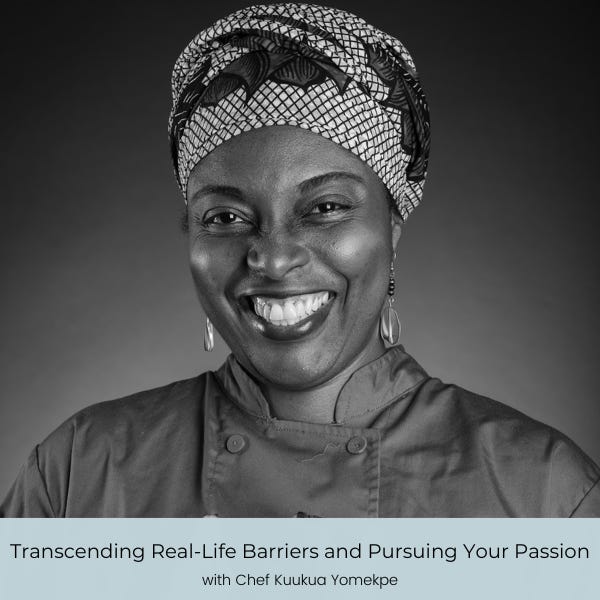
Transcending Real-Life Barriers and Pursuing Your Passion | Episode 44
Description
“When we break bread with others/strangers, we begin to cross boundaries, which in turn creates a bond that removes ‘Other’ from our lexicon even if momentarily.”
- Chef Kuukua Yomekpe
Chef Kuukua Yomekpe is a the founder of Asempke Kitchen a catering, pop-up, and Culinary Experience company that specializes in providing great plant-based options to traditional West African cuisine.
In this episode Chef Kuukua shares her entrepreneurial journey as a queer Black cis-woman living with an invisible disability.
This episode we explore:
🌈 Giving yourself permission to follow your joy
🌈 The impact of Anti-African and Anti-Black bias on building a business
🌈 LGBTQ life in Ghana
🌈 Managing chronic illness and a creative life
Episode Resources
Connect with Chef Kuukua Yomekpe
https://www.asempekitchen.com/
https://www.instagram.com/asempe_kitchen/
Episode edited and produced by Unapologetic Amplified
This transcript was generated with the help of AI. Thank you to our supporting members for helping us improve accessibility and pay equitable wages for things like human transcription.
Have you ever wondered why almost all the health and wellness information you see out there is so white, cis able-bodied and het? I know I have. And as a queer black registered dietitian, I gotta tell you, I'm not into it. I believe health and happiness should be accessible to everyone. That is precisely why I wrote Decolonizing Wellness: A QTBIPOC-Centered Guide to Escape the Diet Trap, Heal Your Self-Image, and Achieve Body Liberation and why I host Body Liberation for All.
The road to health and happiness has a couple of extra steps for chronically stressed people, like queer folks and folks of color. But don't worry, my guests and I have got you covered. If you're ready to live the most fierce, liberated, and joyful version of your life, you are in the right place.
Body Liberation for All Theme
They might try to put you in a box, tell them that you don't accept when the world is tripping out tell them that you love yourself. Hey, Hey, smile on them. Live your life just like you like it
It’s your party negativity is not invited. For my queer folks, for my trans, people of color, let your voice be heard. Look in the mirror and say that it's time to put me first. You were born to win. Head up high with confidence. This show is for everyone. So, I thank you for tuning in. Let's go.
Dalia Kinsey: Welcome back to body liberation for all. today's we're going to be talking about the vibrant world of African cuisine with a special guest. I'm super excited to have her on. I have been trying to explore things that I may have lost because of colonization and on that long list of things that we have lost is our connection to traditional foods and since presumably almost everybody who's of African descent in the US who descended from enslaved people came from somewhere on the west coast of Africa. I've basically been exploring cuisine from the entire west coast of Africa. But I'm still still a novice. So super excited to have Kuukua on today. And because we're going to have some visual references in this episode, I want you to know that you can check out the podcast on YouTube, along with a growing library of videos we're making for you, just like body liberation for all the mission is to promote the health and happiness of queer folks of color.
And. to try and help providers who want to be better hosts for us as well. So if that is something that you would like to tap into, do not forget to subscribe. And if you want to see some of the things we're talking about in this episode, be sure to check out the YouTube video. So welcome to the show, Kuukua.
How are you doing?
Chef Kuukua Yomekpe: I'm doing well. I have had quite an exciting couple of days. I was in Florida. It was nice and very hot. And came back yesterday and it's about 50 something up here. Central New York, finally. Other than that, I mean...
Dalia Kinsey: So, you've been doing a good bit of travel, because we met recently at NGLCC, which is the National Gay and Lesbian Chamber of Commerce, essentially.
And you can tell from the name that it's been around for a while, because the name doesn't really sound like it's including... all of the rainbow. But that's just because it's been around for a while, but it was really exciting to be in a place with so many entrepreneurs, so many queer entrepreneurs. But I was a little surprised at how little focus there was in the content on passion.
My assumption was that a lot of us start our businesses because there's something we're passionate about that we want to share with others. But it really had more of a large business focus, which generally in capitalism, big businesses exist. To make money. There was a need in the market and they seized it.
It doesn't necessarily have anything to do with passion, but when you were talking about what you do, it clearly started with passion. Can you tell us a little bit about your journey to the United States even and then becoming a self trained chef. I'm so impressed by all self trained everything because it's obviously a legitimate way to build skills.
But it's something that I think a lot of us are afraid to even attempt because maybe we've been a little held back by public schooling or traditional schooling kind of leaves you feeling like you can’t do anything without a guide.
Chef Kuukua Yomekpe: To join my mother and her brother who was doing a PhD at Ohio state. And so my mom is an RN, retired RN. And so she was at Mon Carmel in Columbus, Ohio. So that's how we ended up in the US. She had been living away from us since I was four. And so I'd been raised by my grandmother, her mother. So came to the U S when we first came, I realized my mom was making friends, mostly.
Through her nursing colleagues and some other immigrants who were either nurses or in home health. And so she spent quite a bit of time with them, you know, sometimes on the weekends, but not always. But definitely at Thanksgiving and at Christmas and any other major holiday like Labor Day. cooking African, you know, Filipino, Ethiopian, you name it.
We had all the different dishes in the house. And so that kind of sparked my interest in feeding other people because I wasn't trained. I didn't go to school for that, you know, because as an immigrant daughter, you went to school to become a doctor or a nurse or a lawyer or even better if you went into banking, right?
So I got interested in cooking for others and feeding others through all those different potlucks that we were holding. And eventually people started asking us for catering. And so my mom and I got an extra stove and put it in the garage, which was probably illegal. But we did it and started cooking for catering.
Nothing big, you know, like people who were going abroad and wanted to have like a little fundraiser, people who were taking their students to Ghana, who wanted the students to get a taste. So I did a little bit of that and then I moved out to Indiana to work for Notre Dame. So once I got there, I got sort of, I infiltrated the black community.
So there was a lot of students of color who had very little knowledge of Africa. And so I cooked every weekend and had them over in my apartment because I lived in in the dorm. And so that's how that part got started. I left Indiana to California to do my second master's. And while I was there, I started catering, paying for my rent through little side job and then cooking classes.
So that's how it all started, you know, just slowly, slowly building. And then seven years ago, I decided I was leaving higher ed. I'd worked in higher ed about 25 years, and I was going to start my own business. I did it for two years, full time, mostly on loans and credit cards. And then I fell. So I had an accident and while I was carrying some pot.
and could not walk for three months. So I had to put the business on hold, went back to higher ed, and that's how come I ended up in New York in central New York. So it's been a journey of, you know, getting to this point of doing it full time and legally, like being an LLC actually about to convert into an S 4.
So it's, you know, it's kind of through its iteration, and we came to the U. S. in 1996. So it's I think about 27 years of just playing with the idea, going into higher ed, teaching, doing the things that were sort of respectable by the immigrant parent standards, right? And then finally going, this is what I really want to do is work for myself.
And I want to work for myself, feeding people. And that's, that's really where my passion is. It's like, if someone says, thank you, that was the best meal I've had. Thank you. That was so comforting. My job is done, you know, so I feel so good. Oh yeah, that's been my journey. Well, what did your
Dalia Kinsey: parents say or what did, I don't know if there was one parent who's more focused on their vision for what you should do professionally in the Stat




 United States
